Showing posts with label Wilhelm Reich. Show all posts

Larry Flynt Was My Fleece (or How a Book about Sex Turned Me Into a Christian)


by JR Daeschner

In the end, it was the lies that got to me.

I was in Pompeii, you see, researching what I hoped would be my next big book, a History of Sex that would venture between the past and present, revealing the origins of our notions about love and romance.

Besides the obvious reasons, I'd picked Pompeii because of one little-known fact: the Roman ghost town is the site of the first known reference to the word 'Christian,' dating from around the time that the Apostle Paul visited nearby.

Even more intriguingly, the house that contained the 'CHRISTIANOS' graffiti stands across from Pompeii's brothel (and may have been a whorehouse itself).


But what struck me most was an offhand remark by Pompeii's chief archeologist as he tried to explain the exponential growth of an obscure Semitic sect just a few decades after Rome had crucified its leader like a criminal:

"No religion had ever spread so rapidly in such a capillary manner before."

And that got me wondering why.

Having been raised a Christian, I'd turned my back on the faith partly because I believed the lie that Christianity was anathema to knowledge--I thought that the more you learned about the "real world," the less faith you inevitably had.

As I began to discover, though, that wasn't necessarily true.

If anything, I came to realize that Christians have nothing to fear from learning--while the secular world has a lot to lose from an unbiased look at our past.

I soon learned, for instance, that it was Christ and his followers who gifted the concept of redemption to Western culture--the revolutionary promise that even a prostitute could be redeemed (as opposed to the once-a-whore, always-a-whore ethos of the ancient world).

And it was the early Christians who fought to stop Roman infanticide (making the modern Church's stance on abortion remarkably consistent), while it was Christ's gender-neutral character that enabled women to identify with Him and call themselves Christians--or 'little Christs.'

Contrast Jesus with Mohammed--a celibate pacifist versus a warmonger with a harem--and you can see why feminism took root in traditionally Christian societies.

Whereas polygamy inherently devalues women, it was Paul--the supposed source of Christian "misogyny"--who officially broke with Jewish custom and made marriage one-to-one, mandating that each Christian leader have only one wife and (contrary to Roman practice) actually be faithful to her.

In other words, it's very likely that the only reason Western women dare to demand monogamy from men now is because of centuries of Christianization.

Yet somehow the world continues to slander Christianity as "sex-negative"--and misogynistic to boot.

FREUD'S FRAUD

The cognoscenti will tell you that Sigmund Freud, the father of psychoanalysis, is largely disregarded now, while blithely overlooking his pervasive impact on pop culture and the wreckage it's caused.

For instance, thanks to Freud's declaration that all children want to have sex with their parents (the Oedipus complex), many of his followers dismissed actual cases of sex abuse as wishful fantasies.

And it was one of Freud's disciples, Wilhelm Reich, who helped inspire the Sexual Revolution of the Sixties and Seventies, a period that most documentaries depict as an eminently groovy time to be alive.

But have you ever heard them mention its seedy side?

At a time when erstwhile "perversions"--homosexuality, sadomasochism, etcetera--were being declared perfectly normal, many "revolutionaries" argued that pedophilia was just another avenue for sexploration.

After all, who was to say that consensual sex with children was wrong? Or, as a Dutch magazine for gays put it in 1969, "Why Not Go To Bed With Your Son?"

Modern "pedophile activists" still regard those as the good old days. In the Netherlands, I interviewed the co-founder of an ultra-fringe political party trying to legalize pedophilia.

Who did he blame for putting an end to the child-sex movement? An alliance between an all-but-extinct branch of feminism (they wouldn't have called pole dancing "empowering") and--you guessed it--devout Christians.

That was a truth I heard repeatedly, be it from a dodgy Russian biznesman in Venice or an American pimp in Prague: Christianity acts as a check on decadence.

And time and again, I came across Westerners who were having to relearn history's lessons the hard way.

In Amsterdam, I met a former prostitute turned politician who led a crackdown that shut much of the Red-Light District.

"If you're a Christian organization, people don't want to hear (your views on prostitution) because you're Christian," she told me. "But it's new when a politician from the leftwing says it's not good!'

As for pornography, I interviewed one of the makers of the "Max Hardcore" franchise in LA, a man who's filmed some of the worst violence against women outside of warzones.

"With the sex business, you gotta keep ratcheting up," he said. "It's kinda like violence in movies. You gotta keep ratcheting up. People get inured at a certain point—it's gotta be more, greater, nastier. Filthier."

Funnily enough, that's just what porn's (Christian) opponents say.

JUST ANOTHER CASUALTY

Meanwhile, the media routinely hail Hustler founder Larry Flynt as a hero of the First Amendment, a martyr to free speech.

But did you know he once claimed to be a born-again Christian--and that during his conversion, he had a premonition of himself in a wheelchair?

I asked him about it at his headquarters in Beverly Hills. He admitted that if he had closed Hustler after his conversion--rather than continue defending it in court--he might never have been shot, and he wouldn't be paralyzed today.

Up close and in person, rather than a hero, Flynt looks like just another casualty of porn, a man who's made millions but lost everything that counts, including his "soulmate" and much of his family.

All of this eventually resonated with me.

Lie after lie, I kept coming back to the faith whose truths had been proven over centuries: rules and values that built Western civilization, not because God is a god of arbitrary demands, but because "God so loved the world."

Sure, I also experienced some personal and professional disasters (it's surprising how low some of us have to go before finally surrendering).

But ultimately once I realized the truth, the inevitable question became--what do you do with it? Or "who do you say that I am?"

Some may question my decision to publish The History of Sex.

Well, all I can say is I prayed about it. A lot. And Larry Flynt was my fleece (but that's another story…)

For those of you who struggle to reconcile faith with the "real world" (particularly sex), take it from someone who's had to learn the hard way: the Truth really will set you free.

* * *

The History of Sex: Graz and Vienna -- The Prophet of the Second Sexual Revolution? -- (Chapter VIII, Part 37)

In keeping with the demented sci-fi theme, the modern videos on display promoting 'orgone therapy' are cheesily reminiscent of Scientology promos, minus the celebs.

Unlike L. Ron Hubbard, though, the Austrian never lived to see the triumph of his new reich.

As an ex-Commie flogging sex boxes to American gullibles during the Red Scare of the 1950s, it was only a matter of time before Reich attracted the Feds.

In a disturbing parallel to the Nazis' book burnings, the US government ordered all his writings about 'orgone therapy' to be incinerated.

Prosecuted as a fraud and sentenced to two years in jail, Reich died in captivity in 1957, turning him into a martyr of sorts for later free spirits.

In its cover story announcing 'The Second Sexual Revolution' in 1964, Time magazine conceded reluctantly that 'Reich may have been a prophet. For now it sometimes seems that all America is one big Orgone Box.'


And since then, the West's libido has been unleashed to roam the world—and come back and pee on Freud's very own doorstep.

Just down the street from his former home in Vienna is a high-brow erotica shop with a painting of an eighteenth-century woman crouched on a bed, her naked hindquarters quivering in the air.

With a winged penis as its symbol, the store takes its name from de Sade: Die Philosophie im Boudoir


Though its counterpart in London boasts more relics, the Freud Museum in Vienna is obviously hallowed ground, for it's here that psychoanalysis was born—his most famous patients passed through these portals—and it's here that the prophet of a new age was persecuted by the heathens of his own land and forced to flee (Forgive them, Father, for they know not what they do.)

'It was one of the most privileged emigrations of the Nazi regime, because they allowed him to take everything with him,' says the museum's director, Inge Scholz-Strasser, noting that after Freud left, his home became a 'Jew-collecting apartment:' a temporary residence for poor Jews who were dispatched to concentration camps.

The History of Sex: Graz and Vienna -- Orgasmatrons and Orgasm Guns -- (Chapter VIII, Part 36)

Whereas old Sigmund tried to support the status quo—not least because the bourgeoisie kept him in cigars—Reich was an avowed Marxist who aimed to free the libidos of the lumpenproles.

Unfortunately, like his fellow Galician, Sacher-Masoch, he also wasn't right in the head.

Early on, the psychiatrist claimed to have discovered a new form of energy.

'Orgone' derived its name—and power—from the orgasm.

What's more, Reich claimed that this magical sex energy could be captured and concentrated to produce earth-moving miracles.

After fleeing to the US in 1939, he set up a research lab called Orgonon in the boondocks of Maine and started advertising 'orgone accumulators.'


The idea was that patients would sit in these special boxes—they look like posh, blonde-wood porta-potties—and wait for orgasmic energy from the atmosphere to build up in their, um, organs.

Unbelievably, Reichian therapy and many of its offshoots are still going strong today.


To my immense disappointment, though, no one's allowed to sit in the specially imported orgasmatron here in Vienna's Jewish Museum.

In fact, it's strictly verboten to take pictures of it, or the equally bizarre invention that Reich cooked up in his later years (God forbid the technology should fall into the wrong hands).

Convinced of the power of sex energy, the increasingly paranoid scientist built orgone 'guns'—basically, big hollow tubes lashed together—that he claimed could repel enemy UFOs.

Nailed it!

The History of Sex: Graz and Vienna -- The Founder of the First Sexual Revolution -- (Chapter VIII, Part 35)

With his electrified shock of hair, hiss fairy stronk accent and screwball hypotheses, Wilhelm Reich (like Freud) would be laughable if so many people still didn't take him seriously.


In fact, one reason I've come to Vienna is to see the Jewish Museum's temporary exhibit in honor of the archetypal mad scientist.

Whereas Freud was a Victorian at heart, arguing that the libido had to be controlled to preserve society, his Galician disciple was a child of the sexed-up fin de siècle—'Willy' had started having sex with one of his family's maids when he was eleven, and both his parents had killed themselves over his mother's affair with one of his teachers.

Unlike his mentor in Vienna, Reich echoed Rousseau's view that humans were fundamentally good; it was society's hang-ups that were bad.

If people's libidos could be let off the leash, Reich argued, the world would be revolutionized: in fact, he coined the term 'Sexual Revolution' way back in 1930.

A couple of years later, the young psychoanalyst committed an unpardonable sin in Freud's eyes.

While the father of psychoanalysis had been exploring masochism with his daughter, he had also developed a new pet theory: the so-called 'death instinct,' the counterpart to the libido that drove humans to destruction.

Sacrilegiously, though, Reich had the audacity to debunk Freud's latest universal discovery, linking it to just one of many particular character traits.

Freud responded with the standard punishment for anyone who wouldn't kowtow to his godlike self-image: he had him excommunicated from the psychoanalytic church, using his masochistic daughter as his enforcer.

When Reich published his article on 'The Masochistic Character' in 1932, Freud tried to claim that he had written it 'in the service' of the Communist Party.

The History of Sex: Graz and Vienna -- Here's Where It Really Gets Messy -- (Chapter VIII, Part 34)

As a diagnosed masochist (and elementary schoolteacher), then, Anna Freud preached that kids could be taught to control their irrational impulses and conform to society—a notion that sounds far more benevolent than it really was.

In keeping with her father's methods, Anna secretly tested her theories on the children of her lifelong female companion, the heiress Dorothy Burlingham, daughter of artist Louis Comfort Tiffany. Sigmund called her kids 'naughty American children.'

Anna and Sigmund managed to escape the Nazis, 
thanks to the strings pulled by his foreign disciples:
'It was one of the most privileged emigrations of the Nazi regime,' the director of Vienna's Freud museum told me.
'They allowed him to take everything with him.'
 

Obsessed that the boy was homosexual and therefore in her view abnormal, Anna subjected him and his sister to live-in analysis throughout their childhoods.

At first, her methods seemed to work: the children turned into apparently model citizens who married and had children of their own.

Sure enough, the son didn't become gay—but he did end up drinking himself to death.

His sister committed suicide in the same house in north London where Sigmund had 'died in freedom' and Anna had subjected her to experiments (ironically, the house is now a shrine to Freudianism: the Freud Museum at 20 Maresfield Gardens).

And they're still at it:
The Anna Freud Centre in London

As for Anna herself, her dad's dodgy analysis left her with a father complex so severe she ended up dying a 'vestal' virgin guarding his legacy, huddling in his overcoat as an old, childless spinster on Hampstead Heath.

By that time, unfortunately, Anna's theories had been foisted on a generation of schoolchildren on both sides of the Atlantic.

The tragicomic implication of all this is that when the inevitable backlash came, the rebels of the Sixties wound up kicking against the wrong targets.

Behind the scenes, Freud and his disciples were as much (if not more) to blame for creating the consumerism and conformity of the 1950s as the usual scapegoats: namely, religion, bigotry and the nuclear family.

What's more, when a generation of disillusioned rebels tried to break with the past and create a new future, they looked to another misguided follower of Freud as their savior.

* * *

Freud's Birthday: Thus Began the Age of Selling Out

To mark Freud's birthday this month (May 6th), do yourself a favor and check out this must-see series from the BBC called The Century of the Self by Adam Curtis.

You can watch it for free on the Web (in fact, I think that's the only way you can see it; I've tried to do the right thing and buy it, but it doesn't seem to be available on DVD).

The documentary starts starts off by profiling the man who founded modern PR: Freud's American nephew.

Ironically, Goebbels was one of his biggest fans.

Freud
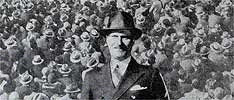
Edward Bernays,
Freud's American nephew

Here are the program notes and the links to each part.

Part I: Happiness Machines


The story of the relationship between Sigmund Freud and his American nephew, Edward Bernays. Bernays invented the public relations profession in the 1920s and was the first person to take Freud's ideas to manipulate the masses.

He showed American corporations how they could make people want things they didn't need by systematically linking mass-produced goods to their unconscious desires.

'You're NOT just one of the crowd.'
A poster from 1933
Bernays was one of the main architects of the modern techniques of mass-consumer persuasion, using every trick in the book, from celebrity endorsement and outrageous PR stunts, to eroticising the motorcar.

His most notorious coup was breaking the taboo on women smoking by persuading them that cigarettes were a symbol of independence and freedom.

But Bernays was convinced that this was more than just a way of selling consumer goods. It was a new political idea of how to control the masses. By satisfying the inner irrational desires that his uncle had identified, people could be made happy and thus docile.

It was the start of the all-consuming self which has come to dominate today's world.

Branded baby
(at Forward Escape)

The programme explores how those in power in post-war America used Freud's ideas about the unconscious mind to try and control the masses. 

Politicians and planners came to believe Freud's underlying premise - that deep within all human beings were dangerous and irrational desires and fears. 

They were convinced that it was the unleashing of these instincts that had led to the barbarism of Nazi Germany. To stop it ever happening again they set out to find ways to control this hidden enemy within the human mind.

Sigmund Freud's daughter, Anna, and his nephew, Edward Bernays, provided the centrepiece philosophy. The US government, big business, and the CIA used their ideas to develop techniques to manage and control the minds of the American people. 

But this was not a cynical exercise in manipulation. Those in power believed that the only way to make democracy work and create a stable society was to repress the savage barbarism that lurked just under the surface of normal American life.


In the 1960s, a radical group of psychotherapists challenged the influence of Freudian ideas in America. They were inspired by the ideas of Wilhelm Reich, a pupil of Freud's, who had turned against him and was hated by the Freud family. He believed that the inner self did not need to be repressed and controlled. It should be encouraged to express itself.

Out of this came a political movement that sought to create new beings free of the psychological conformity that had been implanted in people's minds by business and politics. 

This programme shows how this rapidly developed in America through self-help movements like Werber Erhard's Erhard Seminar Training - into the irresistible rise of the expressive self: the Me Generation.

But the American corporations soon realised that this new self was not a threat but their greatest opportunity. It was in their interest to encourage people to feel they were unique individuals and then sell them ways to express that individuality. 

To do this, they turned to techniques developed by Freudian psychoanalysts to read the inner desires of the new self.


This episode explains how politicians on the left, in both Britain and America, turned to the techniques developed by business to read and fulfil the inner desires of the self. 

Both New Labour, under Tony Blair, and the Democrats, led by Bill Clinton, used the focus group, which had been invented by psychoanalysts, in order to regain power. They set out to mould their policies to people's inner desires and feelings, just as capitalism had learnt to do with products.

Out of this grew a new culture of public relations and marketing in politics, business and journalism. One of its stars in Britain was Matthew Freud who followed in the footsteps of his relation, Edward Bernays, the inventor of public relations in the 1920s.

The politicians believed they were creating a new and better form of democracy, one that truly responded to the inner feelings of individual. 

But what they didn't realise was that the aim of those who had originally created these techniques had not been to liberate the people but to develop a new way of controlling them.

Here are the links again to all four parts: 


Linkwithin

Related Posts Plugin for WordPress, Blogger...