Showing posts with label Literature. Show all posts

The History of Sex: Prague -- 'The State is Pimp' -- (Chapter X, Part 16)

For the most part, the protests against the invasion were fatality-free.

A unique eyewitness account comes from a sex writer who toured Czechoslovakia before, during and after the Prague Spring.

Mankoff's Lusty Europe is a vintage sex guide, one of those books you can't believe was ever published, let alone in 1972—and by a reputable publisher.

Having already ventured behind the Iron Curtain into East Berlin, author 'Allan Mankoff' (rhymes with…) also trawled the streets of Prague.

'There are no apparent pimps,' he concluded. 'The State is pimp.'

Dolled-up 'Tuzex girls' would sleep with foreigners for hard currency to buy Western luxuries in state-run 'Tuzex' stores.

One 'beautiful young coed' was selling herself for thirty dollars a night. 'The Soviet Union will never let us go… and so, I shall sleep with a hundred men and then I shall have enough money to go to England.'


Mankoff also described the tense scene as a schoolgirl mooned Russian troops in the Old Town.

'For a frightening instant, one young guard who looks no more than seventeen teases the nipple of her heaving breast with his bayonet. Then he lowers it, grins, says something dirty in Russian, and the girl runs off in the direction of the macabre, death-mask likeness of Kafka which marks his former residence.'

One of the main goals of the Prague Spring had been to force the Party to punish those responsible for the purges and show trials of twenty years earlier.

The media had taken advantage of its freedom to try to rehabilitate a little-known martyr of democracy and genuine heroine of postwar Europe.

Milada Horakova had fought against the Nazis and spent nearly five years in concentration camps.

Horakova defending herself at her trial

After the War, she resigned from parliament to protest against the Communist coup.

Accused of conspiring against the regime, she was arrested, tortured and sentenced to death in 1950.

Her last words under the gallows were: 'I have lost. I die like a soldier—with honor. I love my country and its people… I wish for you… I wish…'

And then the hangman cut her dead.

'The Communists did what the Nazis never dared to do. On June 27th, 1950, Milada Horakova was hanged.'
You can read this Cold War 'comic book' about her life here.

* * *

The History of Sex: Prague -- Interview with a Spy -- (Chapter X, Part 13)

Against this backdrop, the Czechs used every dirty trick in the book—inventing many of their own along the way.

In one year, 25 of their operatives carried out over 100 campaigns around the world, a success rate that impressed even the KGB.


Sitting in Bittman's office overlooking the Vltava, the Soviets' supreme head of disinformation surveyed a file of Western newspaper clippings containing Communist propaganda.

'If they did not have press freedom,' he remarked, 'we would have to invent it for them.'

To try and clean up the mess he helped create, Bittman took a job as a journalism professor in the US after his defection, changing his name in the process.

With some sleuthing of my own, I manage to find the former spy living in retirement.

Now in his late seventies, he's initially reluctant to talk about the bad old days, though he eventually agrees to speak with me on the phone.

Obviously, I'm very enthused about this—it's like getting to talk with a real-life baddie from a Bond film (Connery era), complete with domed skull and piranha underbite.


Imagine my disappointment, then, when the spy who came in from the cold pours cold water on the Sex School for Spies story.

'I don't think there was a school for this kind of job,' Bittman tells me. 'From a strictly professional point of view, there's always a very strict security protection in the recruitment of an agent, even if it is a prostitute.'

If you had schools, he reasons, 'this would mean that there would be a class of thirty prostitutes, and they would know each other. That is not professional.'

However, he notes that the set-up may have been different at the KGB: the Soviets thought sexual indiscretions were highly compromising, whereas the Czechs were harder to shock.

After all, Czechoslovakia was where Casanova retired to write his memoirs and where archeologists found the oldest ceramic figurine in the world, the pendulous-bosomed 'Venus of Vestonice,' dating from 27,000 BC.

The History of Sex: Prague -- Hammer-and-Sickling Out a Solution -- (Chapter X, Part 2)

In theory—particularly the Marxist-Leninist variety—it was never meant to turn out that way.

In trying to build their secular paradise on earth, the founding fathers of Communism were downright puritanical.

Marx, for instance, seems to have been too busy fathering children and a misbegotten economic theory to dabble in infidelity.

Likewise, his money man, Engels, contended that 'marriage founded on sexual love is of its nature monogamous,' arguing that more men would be faithful if women were truly equal.

Decades later, Lenin also supported women's liberation, mainly because he needed all the lumpenproles he could get to prop up his revolution-wrecked economy.

Even so, when it came to the ancient problem of sex, the first Communists had some trouble hammer-and-sickling out a solution.

Sex in the USSR:
a fascinating book from the 1970s
by Dr. Mikhail Stern

Traditional Russian society had been religiously patriarchal, so one of Lenin's first acts—barely a month after the Revolution—was to outlaw church marriage and replace it with civil registration.

A series of truly revolutionary laws put cohabitation on a par with marriage and made it so easy to divorce that a husband could dump his wife without even consulting her: his ex would be informed via an official 'divorce postcard.'

A dissident Soviet sexologist, Dr. Mikhail Stern, later described the social chaos as a 'total collapse of moral values;' by comparison, America's Roaring Twenties were a feeble meow.

'DOWN WITH VIRGINITY!'

While a few bohemians in the West fooled around with 'free love,' Russia's Young Communists went for the full shag, hailing it as the perfect anti-bourgeois model for society.

In one of the more bizarre episodes, crowds marched naked through the streets of Moscow and other cities in 1922 shouting 'Love! Love! Down with Shame! Down with Guilt!'

In the countryside, wily peasants capitalized on the Communists' sex laws by getting hitched to starving 'seasonal wives' in the spring, using them to help plant and harvest, and then throwing them out during the winter.

In the cities, too, the new economic approach to love tended to be freer for men than women.

'Male students despise the girls who refuse to sleep with them,' a female comrade complained to Pravda. 'They consider them to be politically backward petty bourgeois who haven't been able to free themselves from the prejudices of the old society.'

To liberate their classmates, students at Odessa School Number 49 set up a porn group, while a secret society at another school published a magazine called 'Down With Virginity!'

Meanwhile, their elders held public meetings to discuss whether they should build special booths next to public toilets for the sexually incontinent.

The History of Sex: Berlin -- No Famine of Phalluses -- (Chapter IX, Part 25)

In truth, that image summed up my initial impressions of Berlin's gay scene.

Given Germany's pioneering role in the gay rights movement and the sacrifices made by its homosexuals over the decades, it seemed overwhelmingly tragic that modern Berlin should be just another gay party capital renowned for shopping and shagging.

But then I went to see Karl-Heinz Steinle, the curator of the world's first Schwules Museum: the only 'Gay Museum' in the global village.

One of the museum's exhibits

'I would say that Berlin is actually more balanced than other cities,' he explains. 'Berlin has these dark-sex-triple-gangbang-fuck-rooms—'

—a word I would love to see written in German— 

'—with all the drugs and stuff. And it has, let's say, new ideas, experimental gender-crisscrossed rooms and programs and quite a few historical groups.'

The Schwules Museum began in a flat before the fall of the Wall and now occupies an old industrial workshop; its neighbours are a gay café and a shop called 'Faster, Pussycat!'

'There is one part of gays' thinking that isn't so interested in history, but there is another part which is enormously interested to be able to say "I'm not the first one,"' Karl-Heinz says.

'The museum's development from a little special interest group to the institution that we are now also establishes gay history as a scientific study. It's not done by gays who want to say, "I will collect 2,000 photographs of cocks."'

That said, there's no famine of phalluses in the museum's exhibit on two centuries of gay history.

Inevitably, as with Freud's house in Vienna, Berlin's Gay Museum takes the we-are-the-champions approach to history.

But amid the usual namechecks—nods to the Greeks and Romans, plus Dietrich, Wilde, Auden and Isherwood—it also displays plenty of curiosities: an anal diagram from a French medical text in 1878 showing 'Desordres que produit la pederastie' (it ain't pretty)… Gestapo photos of known homosexuals, taken in three poses (including with and without hats)… and kitsch Seventies copies of him: das magazine mit dem mann featuring weedy sex symbols with bush cuts and sideburns before the American gym-bunny aesthetic conquered the world.

The History of Sex: Berlin -- The Wall Comes Down -- (Chapter IX, Part 18)

Homosexuality wasn't legalized in West Germany until 1969 (once again, East Germany's Communists one-upped their democratic counterparts, having repealed Paragraph 175 the previous year).

By then, though, the main battleground for gay rights had shifted across the Atlantic.

In June that year—just days after West Germany abolished its Nazi statute on sodomy (and the same day as Judy Garland's funeral)—gay men in New York fought back against a police raid of the Stonewall Inn on Christopher Street, inspiring 'Friends of Dorothy' around the world.

West Berlin held its first Christopher Street Day festival a decade later and, by the time the AIDS epidemic took off in 1983, the gay scene was well established.


On the other side of the Berlin Wall, though, the scene was more subdued.

The first East German film about homosexuality, Coming Out, didn't come out until November 9, 1989—the same night the Wall fell.

The History of Sex: Berlin -- 'Such Nice, Pretty Boys' -- (Chapter IX, Part 15)

However, sex was so much a part of Gad's survival that you wonder whether a straight man in his position would have lasted as long as he did.

One of Gad's saving graces, for lack of a better term, was that he had few qualms about having sex with his male protectors.

He got an office job thanks to some help from his Uncle Paul—'which didn't limit itself to the typewriter:' 'we exchanged intimacy deliberately, intentionally, for the first time… It's amazing when you think that at the time he was pushing sixty.'

SOMETHING TO OFFER

And on his twentieth birthday, Gad's German boss took him for ice cream and offered him a place to hide illegals.

'Of course he wanted something in return. He wanted me. I wasn't totally uninterested… I had already noticed he had something to offer in his pants. He was wearing light gabardine slacks that brought out his anatomy nicely.'

One day Gad was told to get in touch with an engineering official named Paul Dreyer who'd helped one of his Jewish lovers escape to Switzerland (another of Gad's unlikely helpers was a middle-aged prostitute who claimed to be an aristocrat).

Ultimately, though, it was a turncoat for the other side who snared him: Stella Kubler, a Jewish femme fatale who hunted Jews in hiding.

The Nazis called Jewish traitor
Stella Kubler 'Blonde Poison'

One of her fellow 'catchers' snared Dreyer in March 1945.


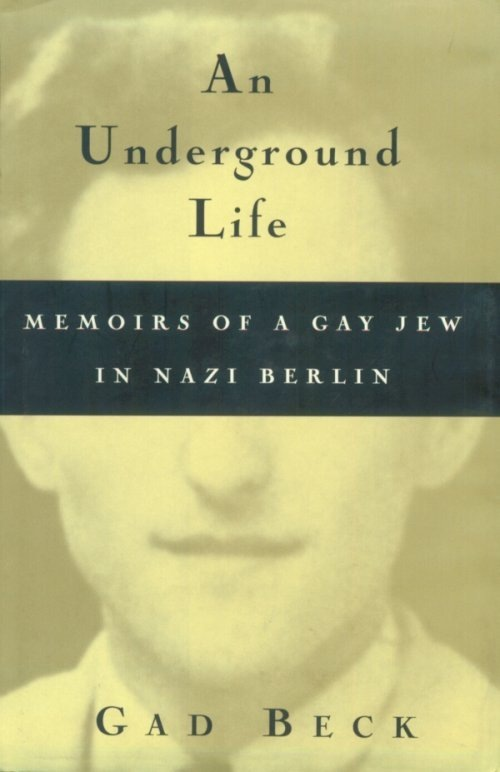
This book was written by one of
Kubler's former classmates at a Jewish school

'He tried to improve his situation during the questioning by claiming he didn't know we were Jews,' Gad wrote.

Instead, Dreyer told his interrogators he'd helped them "because they were such nice, pretty boys."

A few months after the war, Gad saw Dreyer.

'He looked absolutely terrible. They had set two trained dogs on him—specialists in testicles and ears. There wasn't the slightest trace of outer ear to be seen, and he was virtually deaf. With regards to the other body part, he said all that was left was a hole for peeing.'

In the Seventies, Gad bumped into him again.

'He told me—he was around seventy to my fifty-five—that he had by no means given up on sex; there was another spot that had a lot of sensation. I got chills thinking about it.'

The History of Sex: Berlin -- 'I Don't Even Know What That Is' -- (Chapter IX, Part 14)

Likewise, whereas the modern view of homosexuality tends to focus on anal sex and penetration—one expert on 'Greek Love' dates this 'sodomania' from the Seventies—Beck's memoir is a reminder that gay relationships haven't always been about buggery.

Though we're conditioned to think of pederasty as a rite of passage, so to speak—even for heteros these days—many of Krafft-Ebing's homosexual correspondents claimed they preferred everything but anal.

That's not to say that sodomy wasn't part of the gay repertoire—Isherwood was an avid butt man, while Auden had to be treated for a 'rectal fissure'—but anal sex was far riskier before the discovery of penicillin (indeed, that's one theory why Judeo-Christians banned sodomy: to keep their 'chosen peoples' clean and infection-free).

OTHER THINGS TO WORRY ABOUT


Recalling his first love, a fellow Zionist named Manfred, Gad says:

'Whatever we did, it was not much like gay sex as one thinks of it today, but then again, Manfred was not homosexual anyway. With him, as with many of the lovers my age, it was more about joy and fun and sharing hugs and caresses—to feel that the other person was just as aroused as you were… His parents and siblings noticed our relationship, but it didn't have to be talked about. Anyway, there really were other things to worry about.'

Like getting caught.

When Gad was finally captured near the end of the war with another lover, they were both interrogated by the Gestapo.

The officer torturing his friend Zwi taunted them: 'Did you fuck each other in the ass?'

Gad denied it and told him to also confirm it with his partner.

'And the man really did go back in to ask. The door was still ajar, and I could hear Zwi answer, surprised but truthfully, "No, I don't even know what that is."'

The History of Sex: Berlin -- 'A Gay Jew in Nazi Berlin' -- (Chapter IX, Part 13)

Amazingly, some gays managed to survive in the heart of the Reich.

One of the most extraordinary examples is Gad Beck, whose autobiography has an irresistible subtitle (Memoirs of a Gay Jew in Nazi Berlin) and highlights just how much sexual attitudes have changed.


For example, he blithely recounts his first sexual encounter when he was nine or so—with his uncle, who was in his fifties:

'He put me on his lap and kissed me on both cheeks. And suddenly I felt that I was sitting on something! It was warm and firm and felt… well… nice. Nothing else happened. He smiled at me in a special way, mischievous and at the same time loving, which is why I tried to provoke these situations. For the first time, I had erotic feelings in that bottom of mine.'

After messing around with his schoolmates, Gad then had a one-off encounter with his PE teacher at the age of twelve.

'I embraced him and noticed that he was aroused as well. We caressed and rubbed against each other, not even all that much, and then we came, both of us.'

Later, when his mother asked how his day had been, he told her excitedly, 'Really nice. I hugged my gym teacher in the locker room. It was really fun.'

At this point, most modern parents would be on the phone to the police.

But Gad claims his mother 'was not at all upset: "Aha, I thought so," she answered dryly.'


Beck explains her response: 'Relationships between boys and girls were treated much more seriously.'

Mainly because of fears of pregnancy, but also Nazi laws on racial mixing.

'If something had happened with a girl in my class, I probably would have been afraid to say anything. But being affectionate with a male teacher? What could happen?... I came out, as you say nowadays, in a totally nonchalant fashion.'

It seems ironic that even the most liberal parents now, having grown up after both Sexual Revolutions, would act more conservatively than a bourgeois German mother in 1934.

The History of Sex: Berlin -- 'We Knew Too Much' -- (Chapter IX, Part 10)

But the sniping from his own side must have been even more hurtful.

While young foreigners like Isherwood admired Hirschfeld as a 'heroic leader of his tribe,' many of the doctor's one-time allies had begun to view him as a liability.

From the safety of his own closet, the writer Thomas Mann dismissed 'Hirschfeld and his ghastly Committee,' and the leader of Germany's largest organization for gay groups—the so-called League for Human Rights—even started quoting Nazi propaganda against him:

'It is clear that The People's Observer newspaper'—a Nazi mouthpiece—'does not aim to damn homosexuals universally, but instead by and large is striking out only at Jews (especially Magnus Hirschfeld).'

Which made it okay, then.

AND SO IT BEGINS...

However, soon after Hitler took over as Chancellor in January 1933, his 'Campaign for a Clean Reich' shuttered gay clubs and newspapers.

In May, the Nazis stormed the Institute of Sexology, carting away and torching most of its collection and ceremoniously throwing a bust of Hirschfeld onto the bonfire.

Fortunately, the institute's founder was out of the country lecturing at the time: he had the surreal experience of seeing himself burnt in effigy on a newsreel in a Paris cinema (to this day, the stock footage of the infamous Nazi book burnings is usually from the ransacking of the institute). 

Who knew?
This Nazi was probably throwing sex books on the fire

Hirschfeld died two years later in exile.

The Nazis had branded his research center 'an unparalleled breeding ground of dirt and filth.'

However, one official at the institute had a much more intriguing theory: 'We knew too much.'


As the only place for counseling about sexual disorders, the center had treated people from many walks of life, including goose-stepping Nazis.

'Not 10% of the men who, in 1933, took the fate of Germany into their hands were sexually normal,' the assistant director said.

'Many of these personages were known to us directly… and of others we saw the tragic results: a young girl whose abdomen was covered with pin scratchings through the sadism of an eminent Nuremberg Nazi; I refer also to a thirteen-year-old boy who suffered from a serious lesion of the anal muscle brought about by a senior party official and to a youth from Berlin with severe rectal gonorrhea…'

'Our knowledge of such intimate secrets regarding members of the Nazi Party and other documentary material—we possessed about 40,000 confessions and biographical letters—was the cause of the complete and utter destruction of the Institute of Sexology.'

The History of Sex: Berlin -- Splitting the Third Sex Into Two Camps -- (Chapter IX, Part 8)

The first gay-rights activist died in self-imposed exile in Italy before he could see the culmination of his life's work.

On May 15, 1897, a nucleus of friends in Berlin founded the world's first gay-rights group to lobby for the abolition of Paragraph 175, the Prussian statute outlawing 'unnatural acts' between men.

Over the next decade, the Scientific Humanitarian Committee's petition collected 6,000 signatures, including those of Krafft-Ebing and many other heterosexuals.

However, infighting soon split the movement into two camps, so to speak—a divide that's still detectable today.

The Scientific Humanitarian Committee headed up the main group, led by a young doctor who advocated the third-sex theory.

Although noticeably effeminate—his friends called him Auntie Magnesia—Magnus Hirschfeld never publicly acknowledged his homosexuality for fear it would make his (already dubious) research look biased.

The fact that he was also Jewish was not lost on his enemies.

Magnus Hirschfeld,
the 'Hero of the Day'
campaigning to do 'Away with Paragraph 175!'

A widely read work on Sex and Character (written by Otto Weininger, a suicidal Jew in Vienna) equated Jewishness with femininity and blamed Semitism for the decay of Aryan culture.

Meanwhile, an erstwhile ally of Hirschfeld's launched the world's first successful gay magazine, Der Eigene—a word meaning 'self,' 'same' and/or 'different.'

Adolf Brand was what we'd now call 'straight-acting,' the ringleader of a radical minority of gay supremacists, many of whom were anti-Semites to boot.

Adolf Brand
is the one in the upper righthand corner

Styling themselves the Community of the Special, Brand and his followers resented being portrayed as 'stepchildren of nature' by eggheaded pansies.

On the contrary, they argued that pederasty was a lifestyle choice that separated truly macho men from the boys.

Romanticizing both the ancient Greeks and Germans, they painted homosexuality as a higher form of love, contending that they should be free to bugger their fellow men while using straight women to further the Aryan race.

In the blank-slate euphoria after World War One, Hirschfeld hoped that Germany's fledgling democracy would follow the lead of the new Soviet Union and legalize homosexuality.

Instead, the ensuing turmoil fueled a degree of hedonism rarely seen since the days of Sodom and Gomorrah.

For the next fifteen years, Germany became a magnet for sexual 'perverts,' with homosexual magazines sold openly on newsstands, thousands of people around the country joining same-sex associations and more than a hundred gay bars operating in the capital (many of them owned by German Jews, as Hitler noted in Mein Kampf).

The History of Sex: Berlin -- The Problem With Being 'Born That Way' -- (Chapter IX, Part 7)

Whereas buggery had been legal in France since the Enlightenment, gay sex was still very much against the law in Germany.

An effeminate lawyer from Hannover was possibly the first man to 'come out' in the modern sense of the term.

In 1862, Karl Heinrich Ulrichs published The Riddle of Male-Male Love, expounding his theory that homosexuals belonged to a congenitally different 'third sex' that deserved the same rights as the other two.

Ulrichs argued that the male homosexual had the disposition of a woman in a man's body—a precursor of the modern 'gay gene' theory, in the sense that he believed sexual 'inverts' didn't choose to be 'perverts;' they were born that way.

But it's not that simple...

In retrospect, the major problem with the third-sex argument was that it was based on false assumptions.

At the time, even the most forward-thinking scientists believed that men were naturally promiscuous and women passive; that was the only way to hold civilization together.

'If a woman is normally developed mentally and well-bred, her sexual desire is small,' Krafft-Ebing wrote. 'If this were not so, the whole world would become a brothel, and marriage and a family impossible.'

Hmm…

Confronted with the Rigid-v.-Frigid division, you can see why many men (and women) must have felt like misfits, simply because they didn't conform to either stereotype.

With his third-sex theory, Ulrichs tried to win the public over by contending that homosexuality was entirely natural.

Unfortunately, after Darwin, the claim that homosexuals were biologically distinct could also be used to justify their extermination.

The History of Sex: Berlin -- 'The German Vice' -- (Chapter IX, Part 6)

Like history, for instance.

Sooner or later, while slogging through your umpteenth tome on the erotic past, you realize that practically all modern sex histories share one unquestionable underlying assumption: namely, that Sex Is a Very Good Thing Indeed.

Tossing off any pretences of objectivity, even the driest academic works tend to portray 'sexual progress' as being synonymous with 'more sex,' while the only 'good' kind of sexual control is birth control.

As an outsider, it's probably no coincidence that I first noticed this bias while trawling through the literature on homosexuality: I think the book that finally clinched it for me was a university hardback entitled Sodomy in Reformation Germany and Switzerland, 1400-1600.

By one Helmut Puff.

It was then that I realized: if history is written by the victors, you can practically hear Freddie Mercury caterwauling 'We Are the Champions' when you open your average 'queer studies' text. 


Oddly, though, the genre often overlooks one believe-it-or-not fact: contrary to what I would have guessed, the gay-rights movement didn't begin in New York or London—or even Paris or Amsterdam—but in Berlin at the end of the nineteenth century.

As a matter of fact, it was a German émigré (Henry Gerber) who later founded America's first gay organization, naming the Society for Human Rights after the groups he'd been involved with in Berlin.

Some also credit Germany's gay-rights movement with pioneering the term 'activist'—amid a slew of other world firsts.

And not for nothing.

If spanking was le vice anglais, the French called homosexuality le vice allemand.

Homophobia and chauvinism aside, there were many reasons why the Continent's Germanic core became the home of gay emancipation in the nineteenth century.

Perhaps most importantly, Germany's activists had something concrete to kick against.

The History of Sex: Berlin -- Well, Blow Me! -- (Chap. IX, Pt. 5)

As with the S&M tea in Paris, I was a little nervous about wandering into a basement of biker types where no one could hear me scream.

But Stephan assured me: 'If you don't want to do anything, all you have to do is turn away.'

Though he's Bavarian, Stephan speaks English like a wisecracking New Yorker, having acquired the accent from his first boyfriend: a Sephardic Jew from Brooklyn.

While we were at MORE, surrounded by men with their mothers' smiles, Stephan announced that he'd found a US publisher for his Sex Tips for Gays, though he wasn't sure it would sell.

'It has photos of men being fisted up to here'—he measured an imaginary arse mark at his elbow—'and of a penis with sperm flying everywhere. It's not something you ordinarily see in American books.'

It's not something I ordinarily visualize over dinner, either. Particularly not over Königsberger Klopse—meatballs smothered in cream.

BEND OVER!

But then Stephan isn't a mainstream writer.

His author's site includes a photo of him posing with his hand down his pants: you certainly don't get that on ianmcewan.com.

Swallowing another spoonful of creamy potato soup, Stephan informed me that he's also written several novels, as well as individual volumes on anal and oral sex, entitled Bend Over! and Blow Me!, and he's now hard at work on the third in the series, a guide to masturbation called Do It Yourself!

Not your usual DIY manual

'I've had to do a lot of research,' he said with a straight face.

Personally, I was amazed he had any strength left to type.

But I couldn't resist asking: 'Masturbation? How much is there to write?'

'Lots' was the inevitable reply. 'It's such a huge subject. Because everybody does it. It doesn't matter if you're gay or straight or married or single.'

Sadly, as a veteran of Europe's first Masturbate-a-thon, I reckon I could tell Stephan a thing or two about wanking.

When it comes to gay sex, though, I'm a virgin.

'Hedonism among gays is tragic,' he told me. 'Berlin has a very big party scene. You have 10, 15, 25 sex parties every day where you can do everything you could ever imagine. You can have sex round the clock, 365 days a year. What is true about Berlin is that you go out and get what you want and don't care much about anything else.'

* * *

The History of Sex: Berlin -- A Polysexual Party Capital -- (Chap. IX, Pt. 3)

It was while I was over at MORE that I got some useful bondage-bar guidance from the author of Sextips für Schwule Männer, or Sex Tips for Gay Men.

Stephan Niederwieser had recommended the restaurant, which is on the main drag in the gay district, right around the corner from where Christopher Isherwood wrote the stories that became Cabaret, which in turn spawned its own gay icon: Liza Minnelli, daughter of Judy 'Dorothy' Garland.

Stephan had given me good advice when I told him I wanted to see a darkroom.

'You shouldn't go in there with those shoes,' he said, glancing under the table at my feet.

In truth, I'd expected as much—I may be in the ancestral land of Dr. Scholl, but comfy, Velcro-strapped sandals probably aren't the footwear of choice in gay clubs, even on a hot night in Berlin.

'Is that because there's a dress code?'

'Well, that—and you might step in something. Sometimes there are pissing games down there.'

Ohhhh.

My immersion into gay culture has just begun.


In recent years, Berlin has recouped its reputation as a polysexual party capital.

The city's first openly gay mayor, Klaus Wowereit, outed himself in 2001 (before the press could) and has since been re-elected, appearing in public with his partner at events like Pride Week and shocking the tabloids by going out of his way to welcome a hardcore S&M festival to the German capital.

The city boasts not one but two monthly queer-listings magazines, including one named after the Victory Column, or Siegessäule, erected to celebrate Prussian military conquests but now an adopted symbol of triumphant gays.

While Germany's overall birth rate has hit rock bottom—like many European nations, the Germans are effectively dying out—some estimates claim that one in four adult Berliners is homosexual.

An entire queer infrastructure caters to this affluent minority, concentrated in two main districts on both the western and eastern sides of the city.

Berlin's central tourist office offers advice for gay visitors, but the city also has two designated information centers—one for men, the other for lesbians.

Listings advertise bars, shops and dance clubs for cocktails or 'beer-fueled male raunch,' with monikers like 'Le Moustache,' 'ABBA, hallo?!,' 'Boyz 'R' Us' and Ficken3000—Fucking3000—as well as a gimp-mask establishment flogging videos called Cum Hungry and Fist Pigs alongside tins of Crisco, an American-as-apple-pie product that apparently has a whole range of lubricious applications outside the kitchen.

The History of Sex: Graz and Vienna -- Heaven Help Us -- (Chapter VIII, Part 38)

Since Inge joined the museum in 1986, the number of visitors has more than tripled to nearly 80,000 a year from around the world.

The main hotspot for psychoanalysis now, she says, is Eastern Europe and Russia.


'Present Russian society is very open to any therapeutic help. So we have close connections to Moscow and St. Petersburg, because they have severe issues in terms of family problems, homeless children and alcoholism.'

She also notes that at least one Indian doctor has tried to mesh psychoanalysis with his native culture.

'And I'm no expert on this, but I think one of the very interesting future viewpoints will be if Islamic societies would try to integrate psychoanalytic findings in their culture.'

And I'm thinking: heaven help us.

Time's cover from 1993

Like its namesake, the museum tends to promote the Freudian myth rather than the reality, though maybe it's wrong to expect a place called the Sigmund Freud Museum in the homeland of Hitler to be objective. It might be too much to ask—if this weren't the home of modern self-analysis.

As I'm on my way out, a staff member mentions that contrary to the impression the museum gives, Freud actually had his practice downstairs when he wrote some of his most famous works, including The Interpretation of Dreams.

'So we do some lying up here,' the staffer jokes.

Old Sigmund would feel right at home.

* * *

The History of Sex: Graz and Vienna -- Raggedy Ann in Chains -- (Chapter VIII, Part 18)

'There's even an SM Style now,' she continues, citing the pop star Rihanna (SM boyfriend optional).

Our tablemates are a tousle-haired artist and his wife, whose orange pageboy, bright lipstick and striped tights remind me of a Raggedy Ann doll.

Sure enough,
if you Google 'bondage Raggedy Ann,'
this is what you get

Very much to the contrary, she's the model for Axel's new series on Sex and Aggression, which makes me even more appreciative of Max's paintings in the S&M B&B in Venice.

Like most modern artists, Axel can't resist the post-Freudian urge to tell you what his images are trying to say—when of course the truth is, if he could actually paint, the work would speak for itself.

His canvases feature snatches of Krafft-Ebing and Sacher-Masoch plastered above paintings of his wife, who's naked except for bondage straps and pictured in various degrading poses: bending over naked, eating out of a dog bowl and so on.

As in life, her wide eyes are startlingly blank, though in art, she also has a corresponding lack of genitalia: the belt crisscrossing her groin forms a kind of labia.

Flipping through the samples, and sitting next to his apparently mingeless muse, I'm finding it surprisingly hard to make conversation.

WANNA RIDE?

The question I really want to ask—is that really what your bits look like?—probably isn't socially acceptable, even in this crowd.

So I opt for the boringly conventional: 'Sooooooo… how did you two meet?'

Judith tells me a tale reminiscent of Schnitzler's Dream Story, the Viennese source of the film, Eyes Wide Shut.


At twenty-five, Judith found herself married with two children when she realized that—Grosser Gott!—she'd never had an orgasm.

So she took up with Axel, who constructs real-life fantasies for her involving his acquaintances.

'Axel might arrange for me to go to a restaurant, and I'll say, "Is there a taxi driver here?" And a stranger will stand up, and I then go with him.'

Presumably they avoid cabbie hangouts.

The History of Sex: Graz and Vienna -- The S&M Youth -- (Chapter VIII, Part 17)

For the record, Grazy says he mainly likes girls, but he's also been with men, and he doesn't always camp it up, especially not as his day-job alter-ego: Michael the Computer Guy.

He and his girlfriend have a tempestuous romance, he says.

Apropos of which, the Sturm to his Drag interrupts us to have a smoke, and Grazy gallantly follows her outside. 'I don't like her to stand outside alone,' he says.

Though it's hard to see how his presence would help her. What's she gonna say: 'Don't bother me, or my cross-dressing boyfriend will beat you up with his handbag'?

On my right is Angelika, a university student euphemized as a BBW (Big Beautiful Woman) in online parlance.

'This is my first time here,' she says. 'I usually go to another group—the SM Youth.'

I splutter into my beer. 'The what?' 

'The SM Youth: for people aged sixteen to twenty-six.'

Ah, sweet sixteen and never been whipped. 


Well, this is awkward:
a teen fashion label has the same name

'Gosh,' I wonder. 'If you start with S&M at sixteen, where do you go from there?'

'I dunno. I guess they'll find out as they get older.'

For the most part, she tells me, the monthly SM Youth meetings deal with issues like exams… moving house… how to make a bondage chair that converts into a coffee table… and how to build a torture cage from wood to keep the cost down—y'know, questions we all grapple with at one point or another. 

Angelika's writing her thesis on intergender studies at the University of Graz, where both Sacher-Masoch and Krafft-Ebing taught.

'Did you have to read Psychopathia Sexualis for your paper?'

'No—the university didn't have it in the library. At least, I don't think they did. I think I looked it up. I can't remember. I know one thing, though: if I wrote something on SM, it would definitely get published. SM's huge now. When I was growing up, you hardly saw it. But shows like CSI, Law and Order and NCIS often have SM characters—usually the baddies—but you never saw that on Colombo.'

'Or Hawaii Five-O,' I add. 'Spank 'em, Danno!'

She smiles politely; clearly, I'm too old for the SM Youth.

The History of Sex: Graz and Vienna -- 'The Century of Sacher-Masoch' -- (Chapter VIII, Part 12)

You may have blinked and missed it, but Graz was Europe's Capital of Culture in 2003, the same year its most famous son did his bit for world culture in Terminator 3: Rise of the Machines.

Nowadays, though, Schwarzenegger is a former Governator non grata, after Graz's assembly denounced him for sending a convicted killer to his death in California.

(The city hasn't always been so conscientious, however, having produced more than its fair share of Nazis—including Arnie's own police chief father.)

The star of Kindergarten Cop promptly returned a 'ring of honor' to Graz and demanded that it remove his name from the local sports stadium.

MASOMANIA

As for its other infamous son of a local police chief, Graz has also had a tortuous relationship.

The story goes that Sacher-Masoch's widow tried to have his ashes interred in Graz, but the city fathers refused to let his cinders besmirch their soil.

In the sexed-up twenty-first century, however, the dead writer has become an underground celebrity, with at least one French philosophe bemoaning the fact that masochism 'has suffered from unfair neglect' versus sadism, and Ukrainian and Russian intellectuals bickering over which country is the true home of the perversion: Sacher-Masoch's hometown was actually the city of Lviv in Ukraine, which now boasts a Masochist Café and a life-size bronze statue of him, while some Russians argue that he got his taste for a good whipping from their native sect of khlysty, or flagellants.

According to this fascinating Russian blog post on monuments people rub and kiss, the statue "hides a few 'surprises': in chest was mounted magnifying glass through which erotic pictures can be seen, and by putting a hand into the left pocket you can touch its 'man-dignity' for good luck." 

To justify Graz's EU sop in 2003, a local art gallery hosted a full-blown Sacher-Masoch Festival, including a film festival, a conference featuring a domina friend of the Fanny I met in Paris, lectures with titles like 'The Headaches and Rewards of the Dominatrix in the Relationship with a Submissive/Masochist' and a program of 'Masomania' performances, as well as an installation piece featuring a weedy little Pole being bullied by an Austrian (alas, some things never change).

'The 20th century was the century of de Sade,' the festival declared. 'The 21st century will be the century of Sacher-Masoch.'

The History of Sex: Graz and Vienna -- 'To Kill What One Loves' -- (Chapter VIII, Part 11)

These farcical situations turned Sacher-Masoch's life into a tragedy.

Wanda left him for another man, and his second wife, Hulda, ended up having him committed.

According to Sacher-Masoch's biography (The First Masochist by James Cleugh, recommended to me by Finn in Lacoste), one day Hulda found the writer in his study with his favorite cat dead on his lap, ranting about how he'd had an urge to kill the Angora kitten while he was stroking it:

'Ah, to kill what one loves, Hulda! What appalling rapture! It is like killing oneself! To crush, tear, suffocate and destroy another's handiwork, to set the seal of death, of annihilation where God Himself has enthroned life!'

Predictably, he then had nightmares about cats getting their own back:

'I am being eaten alive! It's the cats—they're after me!'


And during the day, he resorted to ever more extreme remedies, including whips of hooks and nails, boiling poultices, red-hot needles, razors, and plenty of salt to rub into his wounds.

Officially, the renowned writer, Leopold von Sacher-Masoch, died of heart failure in 1895, aged 59.

In reality, according to his biographer, he lived for another decade in a German insane asylum—ironically, in the hometown of Krafft-Ebing, the man who ensured his name would never be forgotten.

Leopold and Hulda

* * *

The History of Sex: Graz and Vienna -- From High Drama to Low Farce -- (Chapter VIII, Part 10)

Although the conventional view nowadays is that Krafft-Ebing ruined the writer's reputation, in truth, if anyone ruined Sacher-Masoch's career, it was the Chevalier himself.

Forever striving for high drama, his sexcapades usually collapsed into low farce.

While Wanda was still recovering from the birth of their third child, for instance, her husband excitedly showed her a personal ad from a Viennese newspaper:

'Handsome, rich, energetic young man would like to meet pretty, elegant young woman; admirer of the works of Leopold von Sacher-Masoch preferred.'

The writer himself quickly drafted a reply for his wife, enclosing a photo of Wanda.

The man returned the favor, including a picture of himself in Eastern garb.


'A Turk, Wanda!' Leopold exclaimed. 'Now at last we've got hold of someone who understands how to make love!'

Sacher-Masoch then hastily dispatched his ailing wife to a health spa to have sex with the stranger.

However, Wanda returned the very next afternoon, informing her far from gallant Chevalier that the 'Turk' was actually 'a very nice boy' from Vienna—real name: Nikolas Teitelbaum—whose mother was a friend of the family.

'We talked half the night, but nothing happened,' Wanda told him. 'I felt ill, anyhow.'

LUDWIG THE MAD

In another intrigue, a mystery correspondent tried to sound out whether The Love of Plato might reflect Sacher-Masoch's true tendencies.

Wanda quickly worked out that the fan was a man, not least because of his nom de plume: Anatol.

But Sacher-Masoch fantasized that he was a frustrated 'she-devil,' a manly woman who would beat him like an evil Queen Mother of Constantinople.

The famous author then embarked on a bizarre charade that at one point involved him sitting blindfolded alone in a hotel room at midnight (to meet a man he couldn't see) and at another him and his wife trying to arrange a ménage-a-trois, sitting in the dining room of a hotel in Graz so that Wanda could be seduced by Anatol.

When she was finally summoned upstairs, instead of the deep-voiced man Sacher-Masoch had met, she found a crippled pipsqueak with red hair.

After a tiresome cat-and-mouse game (even Sacher-Masoch got bored), the couple found out years later that they'd been outwitted by two royal friends: Holland's invalid Alexander of Orange and Bavaria's 'Mad' King Ludwig II, who wound up drowning himself and his doctor in a lake (Krafft-Ebing had warned his colleague to keep an eye on Ludwig).

Mad? Me?

Linkwithin

Related Posts Plugin for WordPress, Blogger...